
 uk
 en
 pl
 ru
Automated Stock Trading Robots — What Are They and Are They Worth Using?
7 min read | May 2026 | Automation, software, automated stock trading
Algorithmic trading systems operate 24 hours a day, without emotions and without breaks. Learn how they work, what strategies they use, and what to consider before implementing your own trading bot.
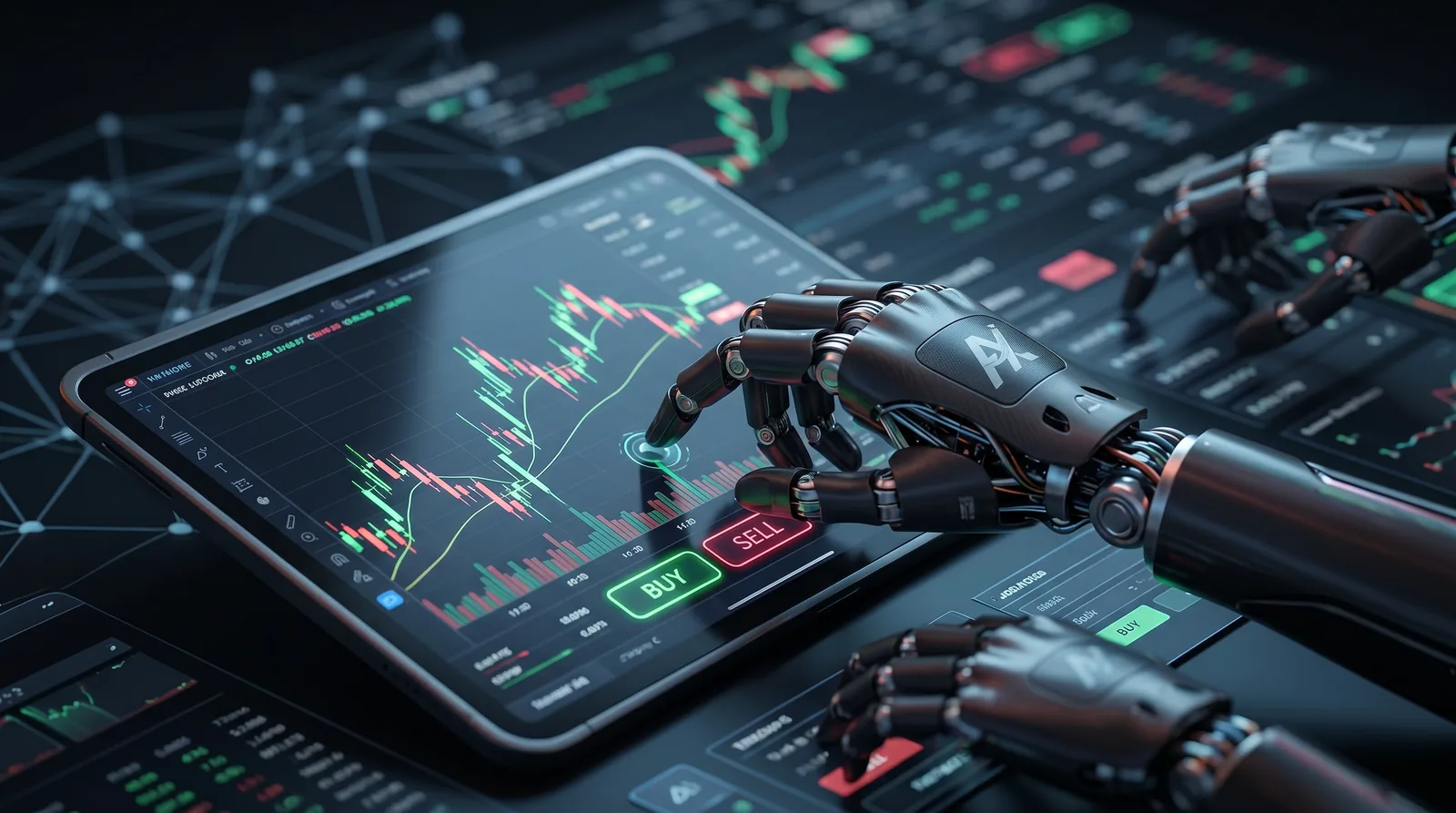
Image generated by AI
What Is a Trading Robot?
A trading robot (also known as a trading bot) is a computer program that automatically executes buy and sell transactions involving financial instruments—stocks, futures, cryptocurrencies, or currencies—based on predefined rules. Unlike a traditional investor, a bot does not need sleep, is not influenced by stress or euphoria, and can make decisions within milliseconds.
Algorithmic trading (also known as algorithmic trading or algo trading) has existed since the 1980s, but the widespread availability of broker APIs and increased computing power have made it accessible to individual investors.
Key fact: According to the Bank for International Settlements, more than 70–80% of trading volume on major stock exchanges and foreign exchange markets is now generated by algorithmic systems.
How Do Trading Algorithms Work?
The operation of a trading robot is based on three stages: acquiring market data (prices, volumes, fundamental data, news), processing that information through a strategy engine, and sending orders to a broker via an API or directly through the investor’s trading terminal. This cycle can repeat hundreds of times per second.
Modern systems use machine learning, social media sentiment analysis, and predictive models based on neural networks. Simpler bots rely on classic technical indicators such as moving averages (SMA, EMA), RSI, MACD, support and resistance levels, and others.
Advantages and Limitations of Automation
Automated trading offers real benefits: eliminating emotional mistakes, monitoring multiple markets simultaneously, and maintaining discipline in strategy execution. A bot does not hold a losing position simply because it hopes for a rebound.
However, automation is not a cure-all. Strategies that appear perfect on historical data may fail under market conditions for which they were not trained. This phenomenon is known as overfitting and is one of the most common reasons why bots deployed by individual investors fail.
FX-ATS — Automated Trading Software
One of the solutions available on the market is the offering from FX-ATS, which provides ready-made software for automated stock trading. A distinctive feature of this approach is full client control—the user independently configures the system parameters according to their own expectations, risk tolerance, and chosen investment strategy.
FX-ATS software is fully compatible with MetaTrader 4 (MT4) and MetaTrader 5 (MT5), as well as with other platforms via API integration, making it compatible with some of the world's most popular trading terminals. The client downloads and installs the software directly into their terminal and then configures the parameters according to their own preferences. No programming knowledge or additional external software installation is required.
FX-ATS software was developed for investors who want to take advantage of automation without having to write code. The system operates according to rules defined by the user and executes transactions based on their instructions.
• Custom Parameters: The client defines the strategy rules according to their expectations. • Risk Management: The ability to set loss limits (stop loss), hedge positions, and define profit-taking levels (take profit). • 24/5 Operation: The system monitors the market and executes orders continuously.
FX-ATS also offers online trading account monitoring—a tool that displays trading performance statistics for your account.
How to Choose or Build Your Own Bot?
Ready-made platforms are available on the market (for example, MetaTrader 4/5 with the MQL language and TradingView with Pine Script). Advanced developers build bots in Python using libraries such as CCXT (for cryptocurrencies) or brokers' direct APIs.
Before deploying a strategy on a live account, it is essential to conduct backtesting on historical data, followed by paper trading—a simulation of trades without real capital—for at least several months. An alternative to building a system from scratch is to use ready-made solutions such as the software offered by FX-ATS, where the user remains the architect of their own strategy.
This article is provided solely for informational and educational purposes and does not constitute investment advice within the meaning of the Act of July 29, 2005, on Trading in Financial Instruments. The content contained in this article should not be interpreted as a recommendation to buy or sell any financial instruments. Investing in financial markets involves the risk of losing part or all of the invested capital. Before making investment decisions, we recommend consulting a licensed financial advisor.